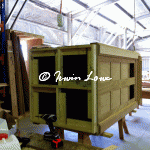
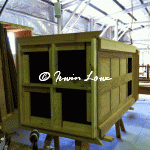
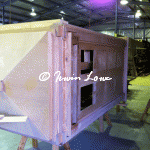
Another day, another bout of sanding, scraping (of obvious blunders), air compressor dust removal, and painting. It’s starting to look the piece.
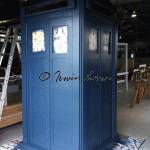
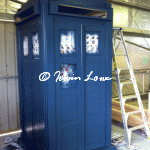

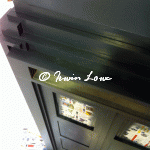
Another day, another bout of sanding, scraping (of obvious blunders), air compressor dust removal, and painting. It’s starting to look the piece.
Well, the excitement builds as some blue goes on. Carefully selected by Anna, there are so many shades of blue the TARDIS has been over its time on tele. from a dirty sort in the old black & white ones to a dull dark one in the 70s to the moody mid 200os one to the in-your-face bright blue one at present.
We’ve gone for a colorbond blue which is sort of a grey-blue but it depends on the light that your looking at it with, of course.
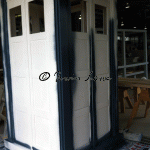
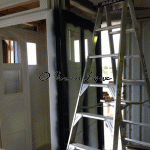
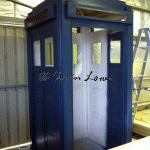
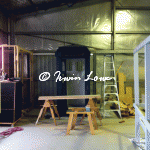
After much spraying of udnercoat, I started to come to grips with the variability of a sprayed finish based on the weather (temperature & humidity), the diltuion of acrylic used (I diluted by about 15%), the pressure on the trigger applied, and the rate of spray itself. Yeesh. Still, I am progressively happier with the finish achieved.
I had some leftover so decided to give the window frames another going over.
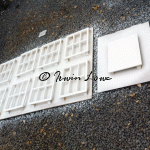

Well, I can see why painters go barmy now. There is so much preparation involved that even with the decision to go with a spray application, the time involved in sanding, and preparing, and sanding (in between coats), and preparing, and sanding makes one go “aaarrrggghhh!!!”
It’s not so much the flat bits, but now that I’m working so intimately on each bit, I have discovered that there are so many detailed fiddly bits. Still, I went with a Wagner branded airless spray gun from Bunnies Warehouse. The first was a W450 at $200 which worked for about 20 minutes then died. During the its meagrely short life, it spattered and splatted unsatisfactorily leaving big and small blobs alike all over the place.
After its demise, I exchanged it with the good people of Bunnies for the $80 less W560. Whereas the W450 has a piston type mechanism, the W560 has a small hair drier type power unit to pressurise and propel the paint. I struggled for a while but then discovered that unlike the W450, the W560 has no inlet valve strainer, so chunks of paint bristles, chipboard, dried acrylic and other assorted floaties had made their way into and blocked the nozzle.
A quick clean, some fresh paint and we were underway again. I must say that, having seen the TARDIS in raw timber for so long, a coat of paint drastically changes the appearance of the construction.
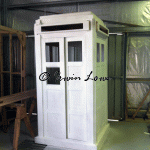

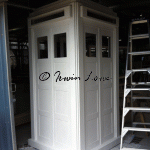
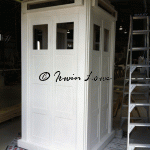
We shifted the TARDIS on its new wheely base into position for sanding, compressed air cleaning & painting. Much preparation. There’s only about 5mm clearance between the base kickboards & the wheels touching the ground, so uneven surfaces really show up.
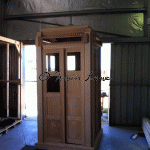
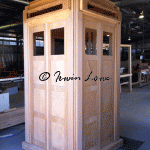
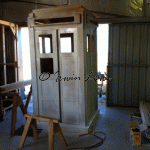
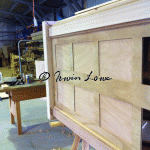
Heading towards the finish now. The base was almost a perfect fit with the kickboard sitting slightly proud by a few millimetres. Some quick planing and sanding later, and all is right. Such a pity to have to paint it, I’ll now complete bogging the few nail & screw holes on the outer surfaces, as well as complete sanding both for a smooth finish & in readiness for painting.
After 2 years of construction, Teacher Pete asked if the TARDIS will fit through my shed door at home.
Yes of course it will, why do you ask…
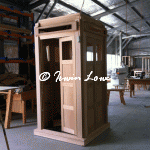
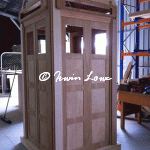
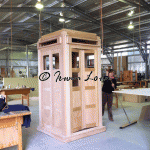
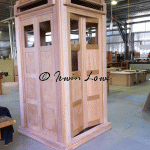
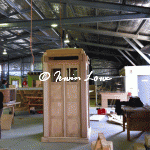
Watching an old episode, I suddenly noticed that each of the 3 sides of the TARDIS bears an architrave feature running down the middle of the panel, mirroring the door-stop architrave on the doors.
Bum! A quick visit to hardware for what I hope is my last purchase of timber for this project, and away. I agonised over whether to make the thickness 8mm so as to match the first step of the horizontal skirting under the lightbox, or to step it to bring it in level with the third ‘step’.
At this late stage, I decided to do the least amount of mucking around, so went for the flat design. I noticed in random viewings of the Baker (2), Pertwee and Hartnell Tardises that both cases are true, so it was a coin toss anyway!

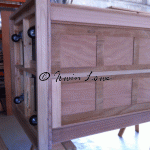
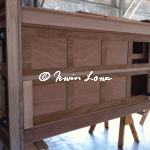
With the structural aspects of the base completed, I finished the plinth & kickboards. There were a few options on cutting the plinth at an agreeable angle, but the easiest way in the end was to set an angle on the ripsaw, but to set the fence a number of mm wider than the timber.
A small amount of shaving with the plane made a perfect match.
Painting was never my forte. I have neither the patience nor the technique, so it was with some horror that I faced 8 windows & 1 hatch panel with the prospect of 2 layers of undercoat and 3 layers of topcoat!
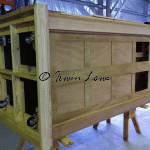
Something I had not thought considered in my construction up until now was the construction of the base. It occurred to me as I watched an old episode or other that there does seem to be quite a lip on the floor. I think I initially thought a flat surface so that K9 (I don’t have one (yet!)) might roll in or out without much hassle.
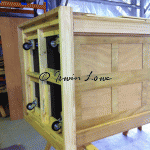
So some plans and sketchwork later, I decided on a structural floor with a kickboard and plinth that matched the tv prop. I also took the opportunity to add some wheels, each with a rated load of 100kg so that should be sufficient to support and shift the structure with relative ease.